
Sex Offender Checks in Hartley County
The Texas Public Sex Offender Registry is the primary official search channel for Hartley County. Texas Department of Public Safety Crime Records Division maintains the public system. It supports searches by a person's name and by a place, so it can answer either a person-specific question or a local safety question. The registry is free to search. It is distinct from the DPS public criminal-history product, a court docket, and a police report.
Start with the official state search because Hartley County does not publish a separate county offender map or alert application. For questions about local registration or suspected failure to comply, contact the Hartley County Sheriff's Office at 806-235-3142. Call before going to 900 Main Street in Channing because no dedicated registration hours or appointment rules are posted.
The official Texas registry information page shows the notices and navigation that frame a lawful public search.
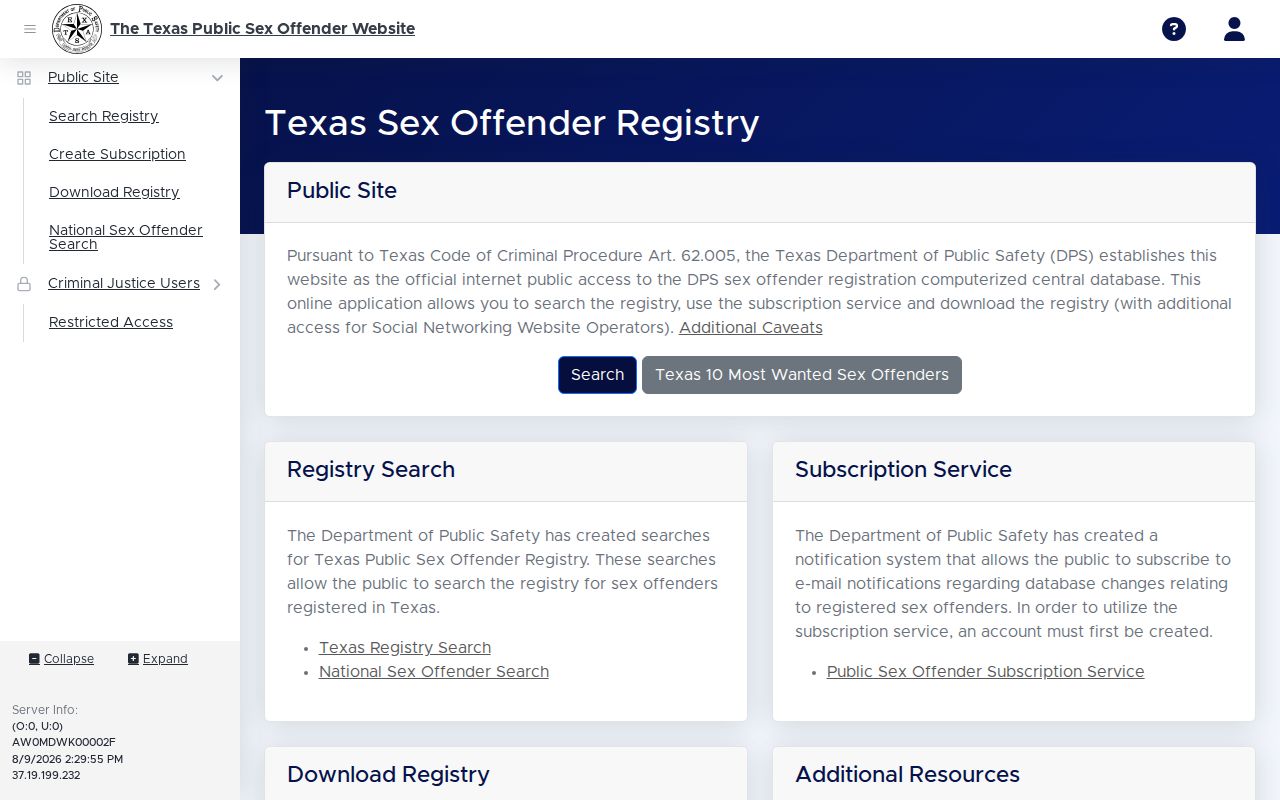
Those notices matter in Hartley County because every search result must be read as reported registry data, not as proof of current criminal conduct.
Hartley County Registry Contact
The sheriff is the practical local registration authority for most of Hartley County. The office can address where a person should report, whether an appointment is needed, or how to pass along a concern about possible noncompliance. It does not replace the public DPS search. A resident seeking an existing public profile should use DPS first and reserve the sheriff's line for a focused local question. The HCSO operational website supplies the office's current public-facing contact route.
Hartley County Sheriff's Office
900 Main Street
Channing, TX 79018
806-235-3142
Mail: P.O. Box 89
Fax: 806-235-2003
A written public-information request is a different process. Hartley County directs written requests by mail, fax, or in person to the elected department that holds the requested record. The county's public-information instructions explain that route. A registry question, an offense report request, and a report of suspected noncompliance should not be treated as the same request.
How to Search the Texas Public Sex Offender Registry
The state form offers several paths. Use the fewest reliable facts needed to begin, then narrow the result. A broad geographic search can help when the exact spelling of a name is unknown. A name search is more direct when the person can be identified with care.
- Open the DPS registry search and read its conditions and warning before continuing.
- Choose a name, location, or institution search. Enter a first and last name when known, or use Hartley County, city, ZIP code, address, and radius controls.
- Compare the result list by photograph, physical description, age information, and place. A shared name alone is not a sound match.
- Open the full public profile and review the registered address, offense, dates, registration status, and reporting details. Recheck the source when decisions depend on current information.
The DPS search screen displays the state registry's current name and location controls.
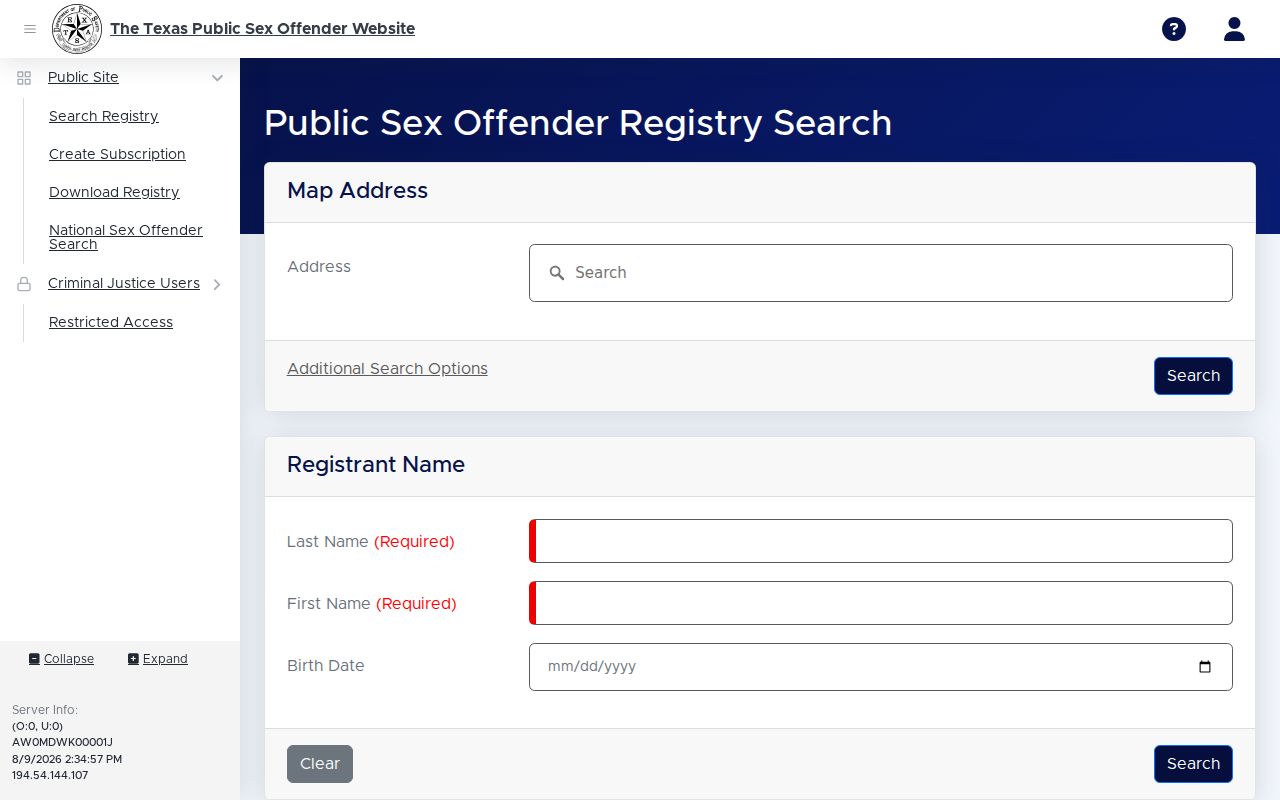
The screen provides multiple ways to narrow Hartley County results without relying on a single name match.
| Field | Type | Required | Use |
|---|---|---|---|
| Last Name | Text | Conditional | Starts a person search; confirm partial or exact behavior on the live form. |
| First Name | Text | Optional or conditional | Narrows a surname result. |
| Address | Text | Conditional | Centers a geographic search. |
| City and County | Text or dropdown | Optional | Use Channing or Dalhart with Hartley County as appropriate. |
| ZIP Code and Radius | Text and dropdown | Conditional | Defines a local area; current radius choices appear on the live form. |
| Institute or School | Search mode | Optional | Uses the separate institution-oriented search when offered. |
Hartley County Registry Locations
Place names require care in this rural county. Channing is the county seat. Dalhart is an incorporated city that crosses the Hartley and Dallam county line. Hartley is a census-designated place, not an incorporated city. A city-only query can therefore miss an address described with a rural mailing name, while a Dalhart result does not by itself prove that the address lies in Hartley County.
Use a layered location check. Select Hartley in the county field. Then run separate city, ZIP, or address-and-radius searches that fit the area of concern. Compare the reported county and address on each profile rather than inferring jurisdiction from the postal city alone. The county covers 1,461.95 square miles, so a short radius around one town cannot stand in for a countywide search.
Note: Geographic results reflect reported address data and the search radius, not a guarantee that every person is physically present at that moment.
Inside a Registry Profile
A public profile combines identity, registration, address, and offense fields. It may include the registered name and aliases, a photograph, physical descriptors, marks or tattoos, and age or birth information to the extent Texas law permits. It can also show a home address, county or city, registration status, and employer, school, or vehicle information when required and public. The offense portion identifies the registration offense and can include the statute, description, conviction or adjudication date, and permitted victim-category information.
| Name and Aliases | Registration name plus reported alternate names used to help distinguish people. |
|---|---|
| Photo and Description | Photograph, sex, race, height, weight, hair and eye color, and identifying marks where public. |
| Registered Address | Reported residence and associated city and county, subject to the profile's current data. |
| Offense Details | Registration offense, statute or description, and conviction or adjudication date. |
| Public Supplemental Fields | Employer, school, or vehicle information when Chapter 62 requires it and public access applies. |
| Registration Status | Status and reporting or compliance information made public by the state. |
A profile is not the underlying court file. It does not reproduce every pleading, hearing, dismissed count, sentence term, or later motion. Readers who need the actual disposition should confirm the case with the appropriate clerk and use the registry only for its public-safety purpose.
Hartley County Registry and NSOPW
The Texas registry is the best starting point for a Texas address. The U.S. Department of Justice's National Sex Offender Public Website adds a cross-state layer. That difference can matter when a person recently moved, a family safety check spans more than one state, or a name-based search may involve records submitted by another jurisdiction.
The official NSOPW search provides national navigation without replacing the source registry.
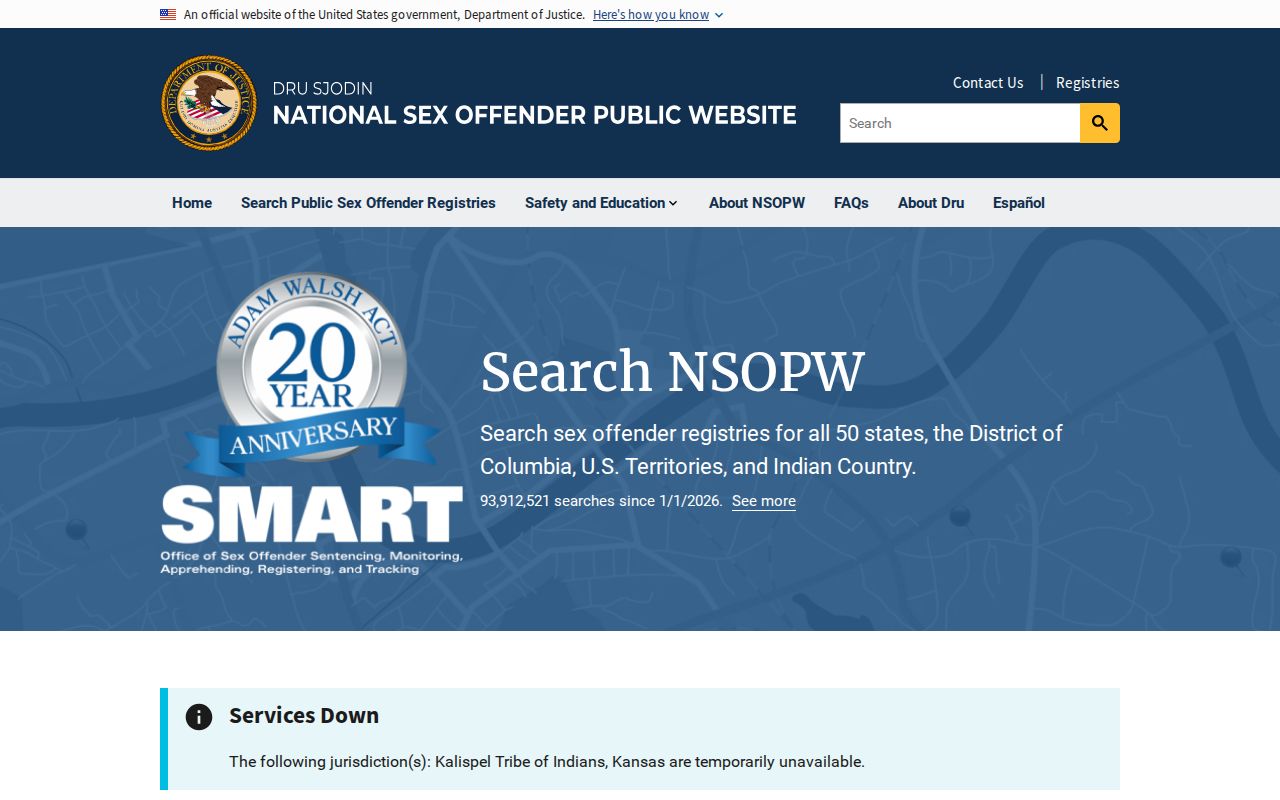
For a possible Hartley County match, return to the Texas profile and contact the proper Texas authority when clarification is needed.
Each channel has a separate role. Texas DPS supplies Texas profiles, Hartley County location filters, and state reporting details. NSOPW searches participating state, territorial, and tribal public registries while leaving each source jurisdiction in control of its data. The Hartley County Sheriff answers focused local registration questions and receives reports of suspected noncompliance, but the office does not replace either public search.
Texas Registration Levels and Requirements
Texas does not place every public registrant into a simple Tier I, Tier II, or Tier III risk label like the common federal shorthand. Chapter 62 ties duration and reporting duties to the reportable conviction or adjudication and other statutory facts. Some listed sexually violent offenses and other statutory categories require lifetime registration. Other reportable convictions or adjudications generally carry a ten-year period after supervision ends, unless another rule controls.
| Texas Framework | Duration | Verification |
|---|---|---|
| Listed sexually violent offenses and other lifetime categories | Lifetime registration where Chapter 62 requires it | Annual, every 90 days, or another period may apply by category or status. |
| Other reportable convictions or adjudications | Generally ten years after supervision ends, unless a different statute applies | Frequency follows the person's statutory category and profile instructions. |
| Individual public profile | Read the displayed requirement and underlying Chapter 62 rule | Do not infer risk from duration or reporting frequency alone. |
The table is a framework, not a case ruling. Chapter 62 contains offense-specific rules and exceptions. Verification can be annual, every 90 days, or otherwise prescribed. Read the individual public profile and the statute before drawing a conclusion about duration, status, or duty.
Verify Hartley County Registry Addresses
A registry map is useful only when the search center and radius fit the question. Check the street, reported city, ZIP code, county, and map placement together. For a Dalhart location, verify which side of the Dallam-Hartley boundary contains the address. For rural land, expand the radius in measured steps instead of assuming a Channing-centered search covers the county.
If a profile appears inconsistent, do not confront the listed person or household. Save the public profile link or enough identifying detail to explain the concern, then call the Hartley County Sheriff's Office at 806-235-3142. Use 911 only for an immediate emergency. Law enforcement, not a private searcher, determines whether reported facts amount to noncompliance.
Hartley County Registry Versus Court Records
The registry answers whether Texas publishes a current registration profile and what that profile reports. A court file answers how charges were filed and resolved. The DPS public criminal-history search reports a legally limited set of Texas conviction and deferred-adjudication information. None of those sources should be treated as a complete substitute for the others.
This distinction is especially important when a name search returns no profile. The person may have no Texas registration duty, the query may not match the reported fields, or the relevant public information may be held by another jurisdiction. Conversely, a registry match does not show every court event and does not state that a new offense has occurred. Use the source that matches the question.
- Registry profile
- A public Chapter 62 record focused on registration identity, location, offense, and status fields.
- Court file
- The clerk's docket and filed documents showing charges, hearings, orders, disposition, and sentence.
- Public DPS history
- The limited Texas name-search product for public convictions, deferred adjudications, and permitted related data.
Community Notification and Lawful Use
Registry information supports lawful community awareness and personal or family safety planning. It can help a resident identify a public profile, understand the registered address that Texas reports, and choose ordinary safety steps. It is not permission to follow, threaten, publish private information about, or interfere with a registrant or the registrant's household.
Texas Code of Criminal Procedure Chapter 62, including Article 62.005, governs public registry information. DPS also places a misuse warning on the official search. The profile should be confirmed at the source, and any suspected breach should be reported to law enforcement through a calm, factual account.
Misuse is a crime: Texas Code of Criminal Procedure Article 62.005 prohibits using registry information to injure, harass, or commit a crime against a registrant or the registrant's family.
Do not treat a listed address as an invitation to visit. For Hartley County, give a nonemergency concern to HCSO at 806-235-3142. Provide the profile information, explain the observed conflict, and let the agency assess it.